




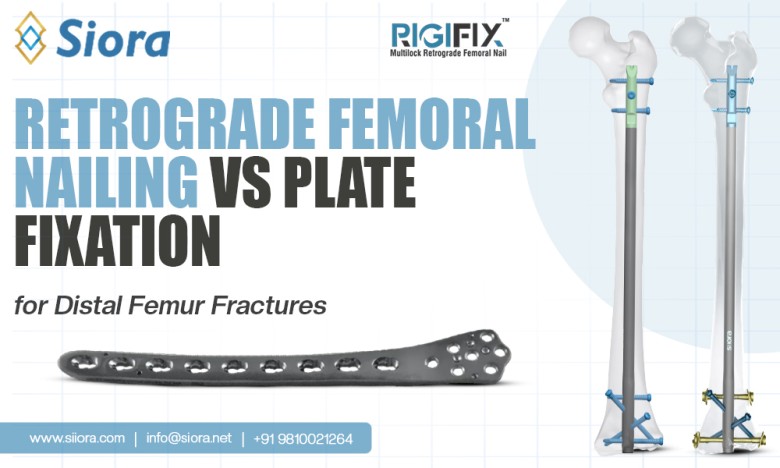
Distal femur fractures are not always easy to manage. These injuries are often seen after high-energy trauma in younger patients or low-energy falls in elderly individuals with weak bones. Because the fracture occurs close to the knee joint, achieving stable fixation while preserving movement can be challenging. Among the commonly used treatment options, retrograde femoral nailing and plate fixation are widely preferred. Both methods have their strengths, and the final choice usually depends on fracture type, bone quality, and surgeon preference.
Understanding Retrograde Femoral Nailing
Retrograde femoral nailing involves inserting an intramedullary nail through the knee into the femoral canal. The implant passes along the center of the bone and stabilizes the fracture internally. This technique is commonly used for extra-articular and selected intra-articular distal femur fractures.
One reason many surgeons prefer retrograde nailing is the smaller surgical exposure required. Since the nail is inserted through a limited incision, soft tissue damage is usually less compared to open plating procedures. Reduced soft tissue disruption can help preserve the blood supply around the fracture site and support faster healing.
Another advantage is the load-sharing nature of the nail. Because the implant lies within the medullary canal, it distributes stress more naturally along the femur. This can be helpful in osteoporotic patients where bone strength is already compromised.
Benefits of Plate Fixation
Plate fixation remains a reliable option, especially for complex distal femur fractures. Locking plates are commonly used because they provide angular stability and allow better control of fracture fragments near the joint surface.
One major advantage of plating is improved visualization during surgery. Surgeons can directly reduce the fracture and restore joint alignment more accurately in complicated fracture patterns. This becomes important in comminuted fractures or cases involving the articular surface.
Modern locking plates also perform well in osteoporotic bone. Multiple screw options help achieve stable fixation even when the bone quality is poor.
Comparing Stability and Healing
Both techniques can provide good outcomes when used in appropriate cases. However, the healing pattern may differ slightly.
Retrograde nails allow controlled micro-movement at the fracture site, which can encourage callus formation and secondary bone healing. Since the implant is placed centrally, mechanical stress is shared more evenly.
Plate fixation, on the other hand, offers rigid stabilization. While this helps maintain alignment, excessive rigidity in some situations may affect biological healing, especially if soft tissue stripping is extensive.
The surgeon’s technique often plays a bigger role than the implant itself. Proper reduction, implant positioning, and postoperative rehabilitation largely determine the final outcome.
Surgical Considerations
Retrograde femoral nailing is generally associated with smaller incisions, shorter operative time, and less blood loss. It may also allow earlier weight-bearing in selected patients.
Plate fixation may require a larger surgical approach depending on fracture complexity. However, it provides greater flexibility in managing fractures close to the joint and allows better correction of alignment problems.
In patients with severe comminution or intra-articular extension, plating is often considered more suitable.
Complications and Challenges
Both methods have possible complications. Retrograde nailing can sometimes lead to knee pain, malalignment, or difficulty controlling very distal fragments. Plate fixation may carry risks such as infection, delayed union, or implant failure if the construct is not balanced properly.
Careful patient selection and surgical planning help reduce these complications significantly.
Conclusion
Retrograde femoral nailing and plate fixation are both effective options for treating distal femur fractures. Neither method is universally superior. Retrograde nails are often preferred for their minimally invasive nature and load-sharing benefits, while plates offer better control in complex fracture patterns. Choosing the right fixation method depends on fracture anatomy, bone quality, and surgical experience. In the end, successful outcomes rely more on proper planning and technique than on the orthopedic implant alone.













Facebook Conversations
Disqus Conversations